What are the different types of Debt and Balanced Mutual Funds?
In the earlier article, you read about the different types of Equity and Solution-Oriented MFs. In this one, we will discuss the different types of Debt and Balanced Mutual Funds.
Debt Funds:
These Mutual Funds invest mainly in Debt instruments like Bonds i.e. where the returns are not dependent on any company performance. However, since they essentially provide loans to different entities, they do run the risk of defaults. Debt Funds differ based on whom they loan money to and for how long.
When investing in Debt Funds, you need to remember that;
- Data available to Advisors for research is usually inadequate. This may lead to improper analysis of Debt and Debt-related securities. Most Investment Advisors, therefore, are not able to give an opinion on Debt securities.
- Corporate Bonds in India tend to be illiquid, as they aren’t traded in the secondary market very regularly, and hence, add liquidity risk to the portfolio. Moreover, they tend to have a lower credit rating, adding credit risk to a portfolio
Debt Funds include,
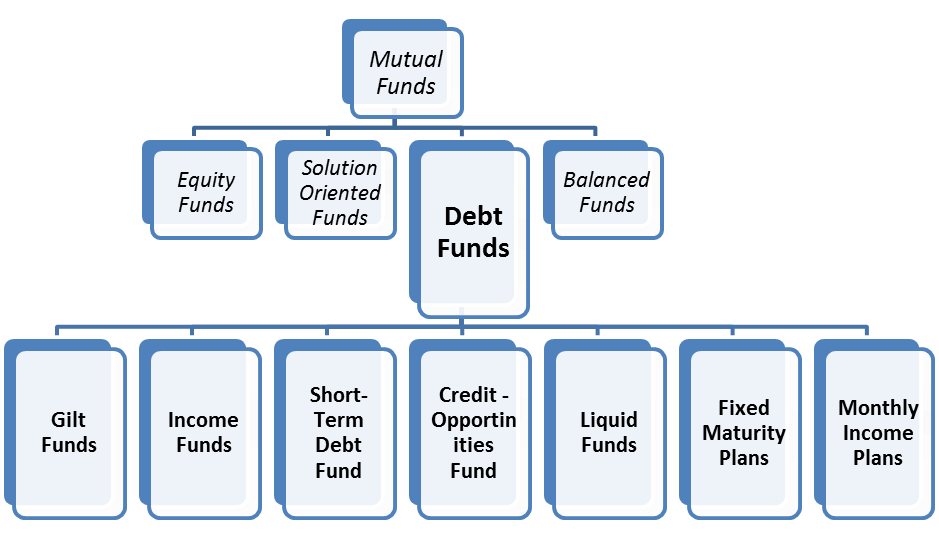
1. Gilt Funds
Gilt Funds primarily invest in Government Securities across different maturities.
For example, long-term Gilt Funds may hold government bonds with maturities ranging from 15 to 30 years. Since these securities are backed by the government, default risk is extremely low.
However, Gilt Funds carry significant interest-rate risk. The longer the maturity of the bonds, the more sensitive the fund becomes to changes in interest rates. As a result, returns can be volatile during changing interest-rate cycles.
These funds are generally suitable for investors with a moderate risk profile who understand interest-rate movements and debt market volatility.
2. Income Funds
Income Funds invest across a mix of Government Securities, Corporate Bonds, and Debentures with varying maturities.
Fund managers actively manage these portfolios by combining:
-
Interest-rate outlook-based decisions
-
Bond trading opportunities
-
Accrual income strategies
Because of this flexibility, Income Funds can perform across different interest-rate environments. However, they still remain sensitive to rate movements, although relatively less than Gilt Funds.
These funds are generally suitable for investors with moderate to relatively higher risk tolerance within debt investing.
3. Liquid Funds
Liquid Funds are designed to provide high liquidity with relatively low risk.
They invest in highly liquid money-market instruments such as:
-
Treasury Bills
-
Commercial Papers
-
Certificates of Deposit
-
Short-term deposits
These securities typically mature within 91 days or less.
Liquid Funds are commonly used for:
-
Parking short-term surplus cash
-
Emergency funds
-
Temporary allocation before equity deployment
They generally offer better returns than savings bank accounts while maintaining relatively lower volatility.
4. Short-Term Debt Funds
Short-Term Debt Funds invest in debt instruments with maturities generally ranging between 2–3 years.
The strategy largely focuses on earning accrual income by holding bonds until maturity rather than aggressively trading interest-rate movements.
These funds are suitable for conservative investors looking for relatively stable income with lower volatility compared to longer-duration debt funds.
5. Credit Opportunities Funds
Credit Opportunities Funds invest in lower-rated Corporate Bonds and Debentures compared to traditional short-term debt funds.
The objective is to generate relatively higher returns by taking additional credit risk.
Since these bonds are usually held until maturity, interest-rate risk remains relatively low. However, the key risk here is credit quality, as lower-rated issuers may face repayment challenges during difficult economic conditions.
These funds are generally suitable for investors with moderate risk tolerance who understand credit-related risks.
6. Monthly Income Plans (MIPs)
Monthly Income Plans allocate a large portion of the portfolio toward debt securities while maintaining a smaller allocation toward equities.
Typically:
-
75–80% is invested in debt instruments
-
20–25% is invested in equities
The debt component aims to provide relative stability, while the equity allocation helps enhance return potential over traditional debt funds.
However, because of the equity exposure, MIPs carry higher volatility than pure debt funds.
7. Fixed Maturity Plans (FMPs)
Fixed Maturity Plans are close-ended debt schemes with a fixed investment tenure, similar in structure to a bank fixed deposit.
Fund managers invest in debt securities whose maturities closely align with the tenure of the scheme. This helps reduce reinvestment risk and improves return predictability.
FMPs are generally considered suitable for conservative investors seeking:
-
Stable returns
-
Better tax efficiency
-
Defined investment horizon
Who Should Invest in Debt Funds?
Debt Funds are generally suitable for investors with:
-
Lower risk appetite
-
Shorter investment horizons
-
Near-term financial goals
Debt allocation also plays an important role in overall asset allocation and portfolio stability.
For shorter durations, such as less than 1–3 years, investors may consider:
-
Liquid Funds
-
Ultra-Short-Term Funds
These can help temporarily park idle cash while earning relatively better returns than traditional savings accounts.
For longer horizons, investors may consider:
-
Corporate Bond Funds
-
Dynamic Bond Funds
-
Government Securities Funds
These categories may offer relatively higher return potential, though with higher volatility and interest-rate sensitivity.
Debt Funds are commonly used for goals such as:
-
House down payments
-
School fees
-
Retirement needs within 3–5 years
However, investors should remember that longer-duration debt funds and lower-rated corporate bond funds can still experience volatility and credit-related risks.
What Are Balanced Funds?
Balanced Funds, also called Hybrid Funds, invest across both Equity and Debt instruments.
A typical allocation may include:
-
~60% Equity
-
~40% Debt
The debt component helps reduce portfolio volatility during difficult market periods, while the equity allocation provides long-term growth potential.
Some Hybrid Funds maintain a fixed allocation between equity and debt, while Dynamic Asset Allocation Funds actively change exposure based on market valuations and opportunities.
What Should Investors Keep in Mind About Balanced Funds?
One important consideration is that Balanced Funds may not always have strict limitations regarding:
-
Equity allocation
-
Market capitalization exposure
-
Sector concentration
As a result, while the debt allocation may reduce volatility, the underlying equity risks may still vary significantly across funds.
Many investors, therefore, prefer creating their own balanced allocation by combining:
-
A pure Equity Fund
-
A Short-Term Debt Fund
This approach can provide greater transparency, flexibility, and potentially lower costs while still achieving portfolio balance through proper asset allocation.
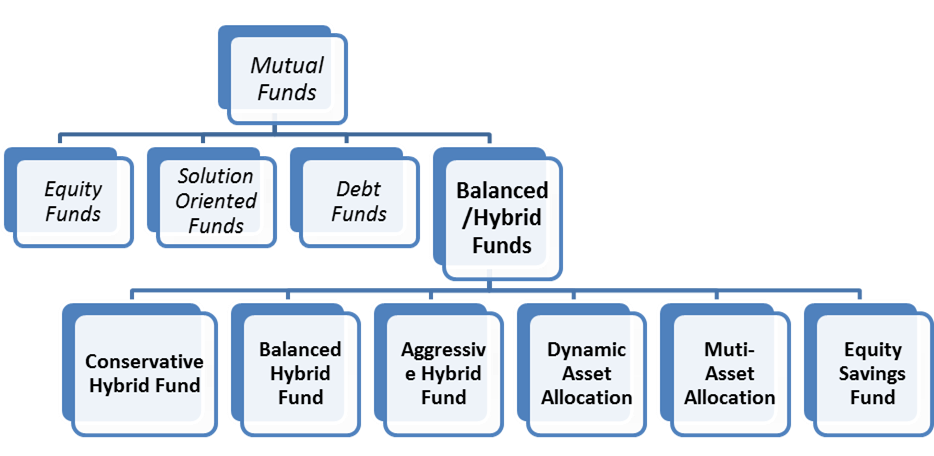
1. Conservative Hybrid Fund
Conservative Hybrid Funds primarily invest in debt instruments while maintaining a smaller allocation toward equities.
Typically:
- 75%–90% is invested in Debt instruments
- 10%–25% is invested in Equity and Equity-related instruments
The objective is to provide relatively stable returns with limited equity participation. These funds are generally suitable for conservative investors looking for lower volatility along with some exposure to equity markets.
2. Balanced Hybrid Fund
Balanced Hybrid Funds maintain a relatively balanced allocation between Equity and Debt instruments.
Typically:
- 40%–60% is invested in Equity
- 40%–60% is invested in Debt
These funds aim to balance growth potential with portfolio stability. Since arbitrage strategies are not permitted in this category, returns are directly influenced by equity and debt market performance.
Balanced Hybrid Funds may suit investors looking for moderate growth with relatively controlled volatility.
3. Aggressive Hybrid Fund
Aggressive Hybrid Funds invest predominantly in equities while maintaining a smaller debt allocation for stability.
Typically:
- 65%–80% is invested in Equity and Equity-related instruments
- 20%–35% is invested in Debt instruments
These funds are designed for investors seeking long-term capital appreciation with slightly lower volatility compared to pure equity funds.
While the debt allocation provides some downside cushion, overall portfolio performance remains significantly linked to equity market movements.
4. Dynamic Asset Allocation / Balanced Advantage Fund
Dynamic Asset Allocation Funds, also known as Balanced Advantage Funds, actively change their allocation between Equity and Debt based on market conditions and valuations.
During expensive market phases, the fund may reduce equity exposure and increase debt allocation. During attractive valuation phases, equity exposure may rise.
The objective is to manage portfolio volatility dynamically instead of maintaining a fixed allocation structure.
5. Multi-Asset Allocation Fund
Multi-Asset Allocation Funds invest across at least three different asset classes.
These may include:
- Equity
- Debt
- Gold
- International assets
- Other permitted instruments
Regulations require a minimum allocation of at least 10% in each of the three asset classes.
The purpose of these funds is diversification across multiple return drivers and risk environments.
6. Equity Savings Fund
Equity Savings Funds invest across Equity, Arbitrage, and Debt instruments.
Typically:
- A minimum of 65% is allocated toward Equity and Equity-related instruments
- A minimum of 10% is allocated toward Debt instruments
These funds aim to provide relatively lower volatility than traditional equity funds by combining directional equity exposure with arbitrage strategies and debt allocation.
They are generally positioned between debt-oriented hybrid funds and aggressive equity-oriented hybrid funds in terms of risk.
Who Should Invest in Balanced or Hybrid Funds?
A: Balanced and Hybrid Funds may be suitable for investors with:
- Moderate risk appetite
- Long-term investment horizons
- Preference for lower volatility than pure equity funds
They can also act as a starting point for investors new to equity markets who may not yet be comfortable handling full market volatility.
While these funds generally experience lower fluctuations than pure equity funds, their long-term return potential may also be relatively lower due to debt allocation.
Investors with investment horizons longer than five years may consider Balanced or Hybrid Funds as part of long-term financial planning. Dynamic Asset Allocation Funds may become particularly relevant during periods of elevated market valuations.
Read the article to know:‘Familiarise yourself with different terminologies used in MF industry’
First published on MoneyWorks4Me, May 2018. Reproduced here for reference; figures and any funds named reflect the original date.
Mutual fund investments are subject to market risks. Read all scheme-related documents carefully. Past performance is not indicative of future returns and the value of investments can fall as well as rise.
Third Rock Wealth, a division of MoneyWorks4Me, is a SEBI-registered Mutual Fund Distributor (AMFI Registration · ARN-361129). MoneyWorks4Me is a brand of The Alchemists Ark Private Limited. We are paid a distribution commission by the asset management company on funds you invest in through us, set per SEBI norms and disclosed in each fund’s Scheme Information Document. We do not provide investment advice within the meaning of the SEBI (Investment Advisers) Regulations, 2013. Regular Plan information only is displayed across this site.